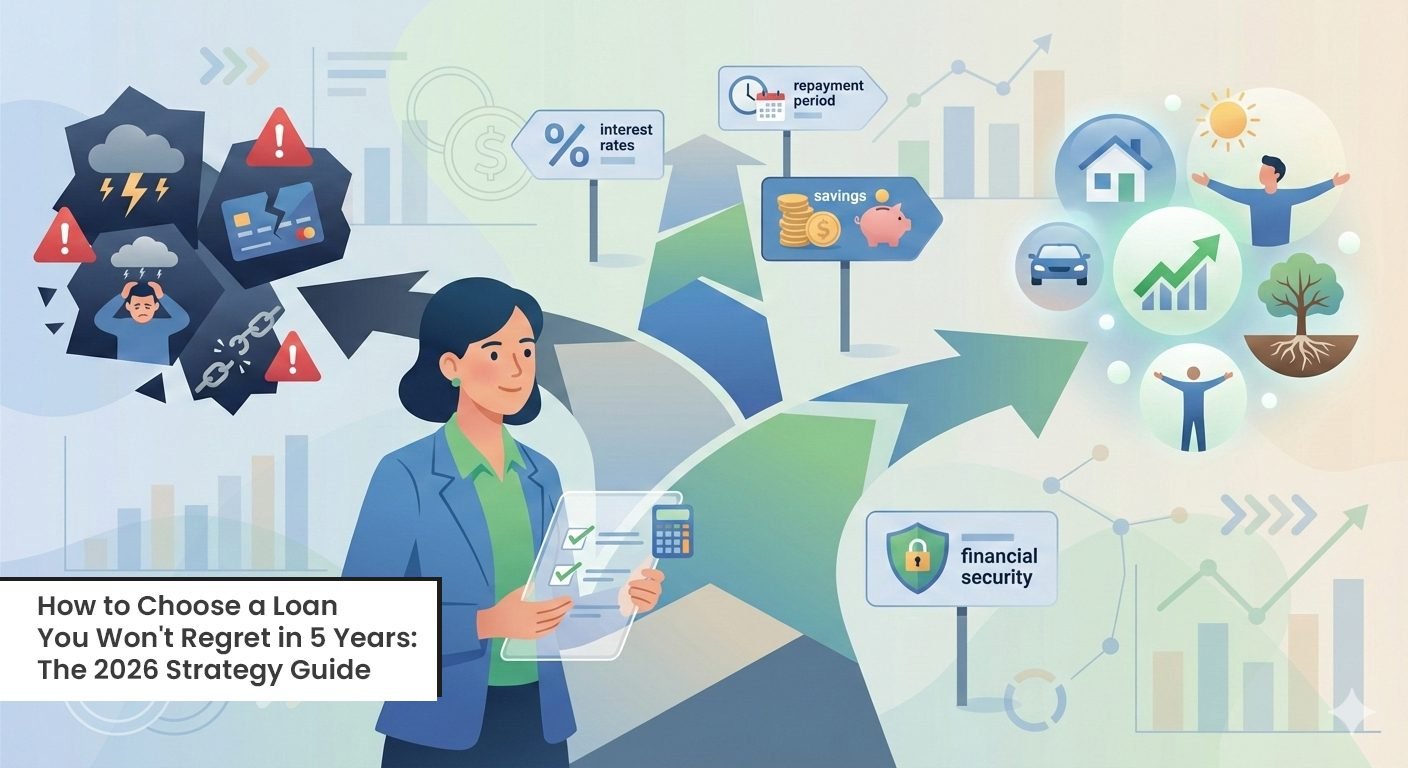
How to Choose a Loan You Won’t Regret in 5 Years: The 2026 Strategy Guide
Choosing a home loan in Australia is one of the most significant financial decisions you will make. A mortgage is not a 30-day commitment — it is a 25 to 30-year financial contract. The difference between a well-structured loan and a poorly chosen one can cost you $50,000 or more over the life of the loan. This guide gives you a factual, step-by-step strategy to compare home loans, evaluate fixed vs variable rates, avoid capacity traps, and choose a mortgage in 2026 that still works for your financial position in 2031.
The “5-Year Regret” — Why Today’s Choice Matters
Most borrowers focus on the lowest advertised interest rate at the time of application. That single variable drives the majority of home loan decisions in Australia — and it is exactly why so many borrowers find themselves locked into a product that no longer fits their life five years later.
The five most common sources of 5-year regret among Australian mortgage holders are:
- Choosing a fixed rate without understanding break fee exposure when plans change
- Ignoring the comparison rate and paying thousands more in fees and charges
- Taking out a personal loan or car loan before a home loan application, reducing borrowing power by $100,000+
- Selecting a loan with no offset account, paying unnecessary interest over the life of the loan
- Refinancing into a loan with early repayment penalties, removing future flexibility
According to ASIC’s MoneySmart guidelines, APRA requires all lenders to stress-test borrowers against a minimum 3% buffer above the actual loan rate. That means if your variable rate is 6.00%, you are assessed at 9.00%. This buffer protects against rate shock — but many borrowers never stress-test their own budget at that level before committing to a 30-year mortgage.
Key Fact: A 0.50% difference in your home loan interest rate on a $600,000 mortgage saves approximately $46,000 over a 25-year loan term. The choice you make today has a compound effect that grows every year for the next 25–30 years.
How Secured Nest Looks Past the Approval to Your 5-Year Financial Health
Most lenders assess your application from their perspective: can we lend this money and get it back? Secured Nest approaches every client differently — we assess your loan from your perspective across a 5-year financial projection, not just today’s approval.
As Sydney’s specialist mortgage broker with 10 years of concentrated Sydney market experience, Secured Nest compares 35+ lenders simultaneously to identify the loan structure that fits your 5-year financial roadmap, not just the cheapest rate today. Our process covers:
- Full borrowing capacity calculation including current debts, credit cards, and HECS obligations
- Rate comparison across fixed, variable, and split loan structures with 3-year and 5-year cost modelling
- Offset account analysis — quantifying exactly how much interest you save by Year 5 based on your projected savings balance
- Exit strategy review — identifying whether early repayment fees, break costs, or LVR restrictions will affect your ability to refinance or sell within 5 years
- Stress-test against a +3% rate rise in line with ASIC MoneySmart guidance to confirm your budget remains serviceable in 2028–2030
Our service costs borrowers $0. Lenders pay us a commission after settlement — typically 0.65% upfront plus 0.15% trailing annually. This commission model means our advice is aligned with finding you the right loan, not the most expensive one.
The 2026 Lending Landscape
New Rules: The February 2026 LTI (Loan-to-Income) Cap
In February 2026, APRA updated its macroprudential guidance to formally restrict Australian banks in issuing high-leverage loans. Under the updated Loan-to-Income (LTI) framework:
- Banks are capped at lending more than 6x income to no more than 20% of their residential mortgage portfolio
- Borrowers with a debt-to-income (DTI) ratio above 6x will face stricter lender scrutiny and documentation requirements
- Non-bank lenders and specialist lenders outside APRA’s direct oversight may retain more flexibility — which is exactly where Secured Nest’s network of 35+ lenders, including regional banks and non-bank institutions, adds measurable value
What this means for you: If your household income is $120,000 and you want to borrow $780,000 (6.5x income), major banks will now assess your application with heightened scrutiny. Non-bank lenders within Secured Nest’s panel can often accommodate this scenario with appropriate documentation.
Interest Rate Reality: Fixed vs Variable in 2026
The Reserve Bank of Australia (RBA) cash rate path through 2026–2028 remains the most discussed variable in Australian property finance. As of early 2026, variable owner-occupier rates from major banks sit between 5.59% and 6.24%. Broker-negotiated rates through Secured Nest’s panel range from 4.95% to 5.15%.
Choosing between a fixed rate and a variable rate requires a 5-year outlook — not a 30-day guess based on the next RBA announcement. Here is a factual comparison of what each structure means across Year 1 and Year 5:
Feature | Impact in Year 1 | Impact in Year 5 |
Fixed Rate (1–3 Year) | Repayment certainty. Budget predictability from Day 1. | Potential break fees of $5,000–$30,000 if you refinance or sell before expiry. |
Variable Rate | Flexibility to make unlimited extra repayments. Eligible for offset accounts. | Full exposure to RBA rate movements. The rate could be higher or lower than today. |
Introductory ‘Honeymoon’ Rate | Low initial cost — often 0.50–1.00% below standard rates. | ‘Rate shock’ when the discount ends and the loan reverts to the standard variable rate. |
Split Loan (50/50 Fixed + Variable) | Moderate certainty on half the loan. Offset account on variable portion. | Balanced exposure. Break fee applies only to the fixed portion if you refinance. |
The 3 Pillars of a No-Regret Loan
Pillar 1: The Comparison Rate vs the Advertised Rate
The advertised interest rate is the headline figure lenders use in marketing. The comparison rate is the true cost of the loan — it combines the interest rate with most ongoing fees and charges, expressed as a single annual percentage.
Under the National Consumer Credit Protection Act (NCCP), all Australian lenders must display the comparison rate alongside the advertised rate. The comparison rate is calculated on a standardised $150,000 loan over 25 years — which means for a $600,000 loan in Sydney, the true total interest payable will differ. Always request a personalised comparison rate calculation for your exact loan amount.
Example: A lender advertises a rate of 5.49%. The comparison rate is 5.81% once a $395 annual fee and $600 establishment fee are included. On a $700,000 loan over 25 years, that difference adds $18,000+ to your total interest payable.
Pillar 2: Flexibility and Features
Two loan features have the highest measurable impact on your 5-year financial outcome: offset accounts and redraw facilities.
Offset Accounts: An offset account is a transaction account linked to your mortgage. The balance in the offset reduces the principal on which interest is calculated daily. If you have $10,000 sitting in an offset account on a $600,000 loan at 5.50%, you pay interest on $590,000 — saving approximately $550 per year in interest from Year 1. Over 5 years, maintaining a $25,000 offset balance on a $600,000 mortgage at 5.50% saves approximately $8,100 in interest.
Redraw Facilities: A redraw facility allows you to access extra repayments you have made above your minimum monthly obligation. It functions as an emergency fund within your debt — reducing your loan balance and daily interest charge while keeping those super funds accessible. Check for redraw fees and minimum redraw amounts, as these vary significantly between lenders.
Pillar 3: Exit and Refinance Strategy
Early repayment fees — also called break costs on fixed-rate loans — are the single biggest source of 5-year regret among Australian borrowers. Break costs on a fixed rate loan are calculated based on the difference between your contracted fixed rate and the current wholesale market rate multiplied by your remaining fixed term and loan balance. In a falling rate environment, break costs can exceed $15,000–$30,000 on a $700,000 fixed-rate loan.
Before fixing your rate, ask these three questions:
- Am I likely to sell this property or refinance within the next 3–5 years?
- Could my income or employment situation change, requiring me to access equity?
- Does this lender allow partial extra repayments on the fixed portion without penalty?
Secured Nest models your exit strategy before recommending any fixed rate product. If your 5-year plan includes selling, upgrading, or refinancing, we weight our recommendation toward variable or split structures to preserve your financial flexibility.
Avoiding the Capacity Trap
Your borrowing power is a finite resource. Every financial commitment you make before or during your home loan application reduces the maximum loan amount a lender will approve. Understanding the hidden costs to your borrowing capacity is essential to avoid the capacity trap.
The Hidden Cost of Personal Loans and Car Finance
Australian lenders assess your borrowing capacity by examining your debt-to-income (DTI) ratio — total debts divided by gross annual income. A $30,000 car loan at 7.5% over 5 years carries repayments of approximately $600 per month. Lenders treat this as a committed expense, reducing your available monthly surplus and your borrowing power.
Existing Debt | Monthly Repayment | Reduction in Home Borrowing Capacity (Approx.) |
$30,000 car loan at 7.5% over 5 years | $601/month | $90,000–$110,000 less |
$10,000 credit card limit (even unused) | Assessed at 3.8% p.a. minimum | $30,000–$50,000 less |
$20,000 HECS/HELP debt | ~8% of discretionary income | $20,000–$40,000 less |
$50,000 personal loan at 9.99% over 5 years | $1,061/month | $150,000–$170,000 less |
The combined impact of a car loan, one credit card, and a HECS debt on a $100,000 income can reduce your borrowing capacity by $180,000–$230,000. For Sydney’s property market — where the city-wide median house price reached $1,587,709 in 2026 — this difference determines whether you can buy in your target suburb or not.
Credit File Preservation
Every formal home loan application places a ‘hard inquiry’ on your credit file. Multiple hard inquiries within a short period signal credit-seeking behaviour to lenders, which can lower your credit score and reduce your approval likelihood. Secured Nest submits a single, complete, optimised application to the most appropriate lender — rather than making multiple applications across different banks that each generate a hard inquiry.
ASIC’s MoneySmart guidelines recommend stress-testing your loan budget against a minimum +3% rate increase above your actual rate before committing. On a $600,000 mortgage at 5.50%, your monthly repayment is approximately $3,673. At 8.50% (the stress-tested rate), that rises to approximately $4,815 per month — an increase of $1,142 per month. Can your budget absorb that in 2028–2030 if rates move? Secured Nest runs this calculation for every client before submission.
Choose Your Type of Repayment
Australian home loans offer two primary repayment structures. Each suits a different financial profile, goal, and tax position.
Principal and Interest (P&I)
The most common structure in Australia. You repay both the principal (the loan amount) and interest with every scheduled payment. The loan balance reduces with every repayment, building equity in the property over time. P&I repayments are standard for owner-occupiers and long-term investors focused on debt reduction.
- Best for: First home buyers, owner-occupiers, long-term property holders.
- Outcome: Loan fully repaid at the end of the term (typically 25–30 years).
- Interest deductibility: Full interest portion is tax-deductible for investment properties.
Interest-Only (IO)
You pay only the interest charged on the outstanding loan balance for an initial period — typically 1 to 5 years. The principal does not reduce during this period. Repayments are lower short-term, but your total interest payable over the life of the loan is higher because you are not reducing the principal.
- Best for: Property investors seeking to maximise negative gearing benefits, short-term holders
- Risk: Repayments increase significantly when the IO period ends and P&I repayments begin
- Lender restriction: Most lenders limit IO periods to 5 years for owner-occupiers, 10 years for investors
Important: ASIC and APRA both warn that interest-only loans carry higher long-term cost risk. On a $700,000 loan at 5.50%, choosing a 5-year IO period instead of P&I adds approximately $40,000 in additional total interest payable over a 30-year loan term.
Checklist — The Secured Nest 5-Year Loan Verification
Before you sign any loan documentation, run through this checklist. Every ‘no’ answer represents a potential source of 5-year regret.
☐ Does the comparison rate beat the Big Four banks’ standard variable rate? (Current Big Four range: 5.59%–6.24%)
☐ Can I make extra repayments without a fee or cap? (Fixed rate loans often cap extra repayments at $10,000–$30,000 per year)
☐ Is there an offset account attached to reduce total interest payable over the life of the loan?
☐ Have I stress-tested my repayments at +3% above my actual rate for 2028–2030?
☐ Have I confirmed there are no excessive early repayment fees if I refinance or sell within 5 years?
☐ Has my broker compared at least 35+ lenders — not just the Big Four banks?
☐ Have I reviewed the impact of all existing debts (car loans, credit cards, HECS) on my borrowing capacity?
☐ Does the loan structure match my 5-year property plan — owner-occupier, upgrade, or investment?
Why Expert Guidance Beats DIY Home Loan Search
The Role of a Mortgage Strategist vs a Standard Broker
A standard mortgage broker presents loan options from their lender panel and processes your application. A mortgage strategist — the approach Secured Nest takes — integrates your loan choice into your broader financial picture: future income projections, property investment goals, tax position, and refinancing timelines.
Factor | Standard Broker | Secured Nest Mortgage Strategist |
Lender Panel | 15–25 lenders typically | 35+ lenders including specialist non-banks |
Rate Negotiation | Standard published rates | 0.10–0.30% below advertised rates + cashback $2,000–$4,000 |
Pre-Approval Speed | 3–7 business days standard | 24–48 hours on business days |
5-Year Planning | Focused on current application | Stress-test, exit strategy, DTI modelling included |
Ongoing Service | Limited post-settlement contact | Annual rate reviews, refinancing alerts, equity access guidance |
Cost to Borrower | Some charge $500–$2,000 fees | $0 — lender-paid commission only |
How Secured Nest Navigates the 2026 Non-Bank Lender Market
In 2026, the most competitive home loan rates in Australia are not always available through the Big Four banks. Non-bank lenders and regional banks — including institutions like Pepper Money, Liberty Financial, La Trobe Financial, Bendigo Bank, and Suncorp — frequently offer variable rates 0.20–0.40% below major bank equivalents with comparable product features.
These institutions are not always accessible through direct applications or limited-panel brokers. Secured Nest’s direct relationships with 35+ lending partners — built over 10 years of Sydney market operation — mean we can access products, rates, and cashback offers that are not advertised publicly. For high-LVR borrowers, self-employed applicants, and SMSF investors, non-bank lenders often represent the only viable approval pathway.
Compare Interest Rates
Lender Type | Variable Rate Range (Owner-Occ P&I) | Best Feature |
Big Four Banks (CBA, Westpac, NAB, ANZ) | 5.59% – 6.24% | Branch network, brand trust |
Regional Banks (Bendigo, BOQ, Suncorp) | 5.14% – 5.45% | Lower rates, offset accounts |
Non-Bank & Online Lenders | 5.08% – 5.29% | Flexible approval, specialist products |
Best Broker-Negotiated Rate (Secured Nest) | 4.95% – 5.15% | Below-market rate + cashback up to $4,000 |
Compare Home Loans — Fixed Rate vs Variable (2026)
Fixed Term | Interest Rate Range | Key Consideration |
1-Year Fixed | 4.99% – 5.39% | Short certainty window. Low break cost risk. Revert rate critical. |
2-Year Fixed | 4.94% – 5.49% | Balanced option. Review revert rate at expiry in 2028. |
3-Year Fixed | 4.85% – 5.44% | Popular for budgeting. Break costs apply through to 2029. |
5-Year Fixed | 5.45% – 5.89% | Highest certainty, highest break cost exposure through to 2031. |
Variable Rate | 4.95% – 6.24% | Full flexibility. Rate moves with RBA cash rate decisions. |
Get Your 5-Year Loan Projection with Secured Nest Today
Secured Nest provides every client with a personalised 5-year loan projection — including stress-tested repayments at +3%, offset savings modelling, and a rate comparison across 35+ lenders. The service is 100% free. Contact us at enquiry@securednest.com.au or visit securednest.com.au to speak with a broker.
Conclusion
Choosing a home loan in Australia in 2026 is more complex than comparing advertised interest rates on a comparison website. The February 2026 LTI rule changes, the shift in RBA rate expectations, Sydney’s median house prices above $1.58 million, and the wide gap between bank-advertised rates and broker-negotiated rates all mean that the decision requires a structured, expert-informed approach.
The no-regret loan is not necessarily the cheapest loan today — it is the loan that fits your borrowing capacity, your 5-year financial plan, your exit strategy, and your budget stress-tested against a rate rise. Secured Nest builds that plan for every client, across 35+ lenders, in 24–48 hours, at zero cost to you.
Review your current mortgage or start your first home loan application at securednest.com.au.
FAQ — Frequently Asked Questions
Focus on the comparison rate rather than the advertised rate. Prioritise loan features that reduce your total interest payable — specifically an offset account and the ability to make unlimited extra repayments. Stress-test your budget at your actual rate plus 3% to confirm you can still service the loan in a higher rate environment. Compare at least 35+ lenders through a licensed mortgage broker to access the full market, including non-bank lenders where the best rates frequently sit.
The Loan-to-Income (LTI) rule updated in February 2026 restricts Australian banks from issuing loans where the borrower’s total debt exceeds 6x their gross annual income to more than 20% of their residential mortgage portfolio. Borrowers with a high DTI ratio above 6x will face additional documentation requirements and may be declined by major banks. Non-bank lenders within a specialist mortgage broker’s panel often retain more flexibility for these borrowers.
Fixing your interest rate in 2026 depends on three factors: your need for repayment certainty, your plans to sell or refinance within the fixed period, and your view on RBA cash rate movements. If you plan to hold the property for 5+ years without refinancing, a 2–3 year fixed rate at current levels (4.85%–5.44%) provides budgeting certainty. If you plan to sell, upgrade, or access equity within 5 years, a variable or split loan structure preserves financial flexibility and avoids break fee exposure.
Personal loans reduce your home loan borrowing capacity by increasing your committed monthly expenses and your debt-to-income ratio. A $30,000 personal loan at 9.99% over 5 years carries approximately $1,061 in monthly repayments, which reduces your home loan borrowing capacity by $150,000–$170,000. Pay off or close personal loans before applying for a home loan where possible to maximise your borrowing power.
No licensed Australian lender can legally provide a consumer credit product without conducting a credit assessment under the National Consumer Credit Protection Act (NCCP). Every formal loan application involves a hard credit inquiry, which is recorded on your credit file for five years. Secured personal loans backed by an asset such as a car or property typically offer lower rates and easier approval than unsecured personal loans, but both require a credit check.
A secured personal loan is a personal finance product where the borrower offers a physical asset — most commonly a car, motorbike, or boat — as collateral against the loan. If the borrower defaults, the lender has the legal right to repossess and sell the asset to recover the outstanding debt. Secured personal loans typically carry lower interest rates (6%–12% p.a.) than unsecured personal loans (10%–20%+ p.a.) because the lender’s risk is reduced by the collateral.
An unsecured personal loan is a personal finance product with no collateral attached. Approval is based on the borrower’s credit history, income, and debt-to-income ratio alone. Because the lender has no asset to recover in a default event, unsecured personal loans carry higher interest rates — typically 10%–20%+ p.a. in Australia — and stricter credit score requirements. Taking out an unsecured personal loan before a home loan application will reduce your borrowing capacity and may be viewed negatively by mortgage lenders.
The most common home loan term in Australia is 30 years. A minority of borrowers choose 25-year terms for lower total interest payable. ASIC’s MoneySmart guidance recommends selecting the shortest loan term you can comfortably afford — every 5 years you remove from a 30-year mortgage reduces your total interest payable by approximately 15%–20% on a standard loan amount.
Compare the comparison rate — not just the advertised interest rate — for identical loan amounts and terms. Use the comparison rate as a baseline, then examine offset account availability, redraw facility terms, extra repayment caps, break cost structure, and ongoing fees. A mortgage broker with access to 35+ lenders can generate side-by-side comparisons across all major and non-bank lenders, including broker-only rates that are not publicly advertised.
Australian lenders do not publicly disclose a single minimum credit score threshold, as approval depends on multiple factors beyond the credit score alone. Generally, a credit score above 700 (on a 0–1,200 scale used by Equifax) is considered good and opens access to mainstream lenders. Scores between 580 and 699 may require specialist or non-conforming lenders at higher rates. Secured Nest assesses your credit position before application and identifies the lender most likely to approve your specific profile.
Secured Nest Finance | securednest.com.au | enquiry @securednest.com.au | Campsie NSW 2194
This content is for informational purposes only. It does not constitute financial advice. Secured Nest Finance holds an Australian Credit Licence. Always obtain independent financial advice before committing to a home loan product.